
All About Head Lice
Where Do Lice Come From ?
Lice spread primarily through direct head-to-head contact with an infested person. They can also be transmitted through the sharing of personal items, such as hats, hairbrushes, combs, and towels. Children in schools, daycare centers, and summer camps are at higher risk due to close contact.

About Lice
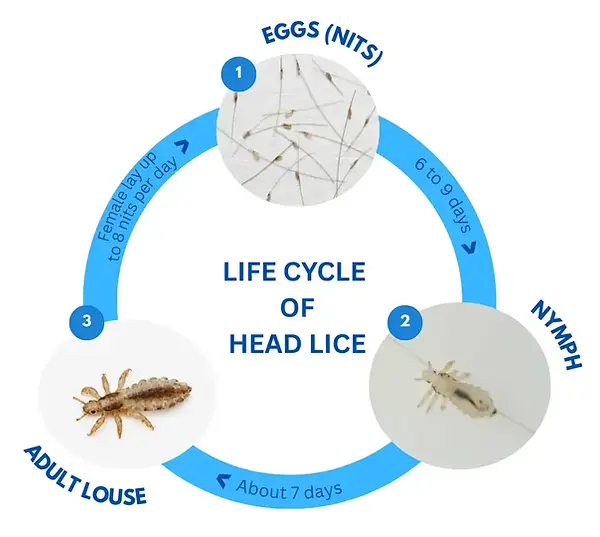
Head lice are tiny parasitic insects that live on the scalp of human beings and are attached to the hair shaft. Lice are not a source of disease, but a social problem. Early lice check and proper lice removal are important to control and prevent the spread. Lice develop in three stages: nit, nymph, and adult louse.
Nits (Lice eggs)
Nits (Lice Eggs) are oval-shaped lice eggs laid by adult female head lice near the base of the scalp. They are approximately 0.8 mm in size—about the size of a sesame seed—and can sometimes be mistaken for dandruff. Nits may resemble the color of the host’s hair and are firmly attached to the hair shaft by a glue-like substance, making them difficult to remove. Nits typically hatch within 7–10 days. During her reproductive life, a female louse can lay several eggs per day, with the number varying throughout her life cycle.
Nymphs
Nymphs are when a nit hatches; a nymph is born. They are smaller versions of adult lice, with 6 legs, each with a claw at the tip. Growing nymphs need to be close to the scalp for warmth and to feed on human blood several times a day to survive. The nymphs molt as they grow, eventually reaching the adult phase.
Adult Lice
A fully grown head louse is approximately 2–4 mm in length. Lice can range in color from grayish to brown or black and may resemble the color of the host’s hair. They do not have wings and cannot fly or jump; they move by crawling through the hair and can spread primarily through direct head-to-head contact.
When separated from the human scalp, lice have limited survival because they rely on blood meals to live. They generally cannot survive for long away from a human host.
A female louse can lay eggs during her reproductive life, which typically lasts several weeks.
How Is It Spread?
Lice move quickly from one head to another, but they cannot jump or fly. Sharing personal items (combs, hats, brushes) or bedding can sometimes contribute to their spread, but head-to-head contact remains the most common mode of transmission

Information For Parents
How do children get head lice?
Lice are not attracted to dirty hair. In fact, they are more likely to be found in clean hair. Lice do not jump, hop, or fly—the only way they move is by crawling.
They are transported on belongings such as combs, brushes, towels, beds, couches, pillows, carpet, stuffed animals, hats, coats, sports helmets, and clothing. Children are particularly susceptible in close-contact settings—such as during playtime, in classrooms, or in daycare centers—where lice can be easily transmitted from one child to another.
Information For Schools
School environments offer ideal conditions for head lice to spread from one child to another, due to the close contact that occurs during playtime, classroom activities, and group settings.
How to prevent a lice infestation at your school?
Early detection is crucial for minimizing the risk of an infestation. We recommend:
-
Conducting screenings at the beginning of the school year.
-
Carrying out additional screenings after major holiday breaks.
-
Educating staff, students, and families on prevention and early identification.
Proactive measures help reduce the spread of head lice, ensuring a healthier school environment free from these parasites.

School Lice Screening Service
We are committed to keeping schools lice-free.
-
Same-day emergency service available.
-
Expert technicians provide accurate diagnoses.
-
Fast, efficient, and reliable screenings.
-
A caring and child-friendly approach.
Because we love children, and their well-being comes first.